Showing posts with label Saturday Shorts. Show all posts

Saturday, November 14, 2015

Visions of the Future: Top 5 Moon Landing Predictions

That the United States successfully landed the first human beings on the moon in 1969 is common knowledge. However, it is less commonly known that many details of this momentous accomplishment were predicted by science fiction decades prior to the actual event.

Here are, in chronological order, five correct predictions science fiction made,(sometimes even inadvertently), about the first moon landing.


1. From the Earth To The Moon by Jules Verne (1887)-


You may be tired of hearing about Jules Verne by now. If so, too bad. This is a series on science fiction history. He is going to come up a lot. While the Apollo 11 mission didn’t see its crew members launched out of a giant cannon towards the moon, many of Verne’s calculations were close to feasible. Perhaps one of the most fascinating coincidences surrounding the story is that Verne’s characters blasted off from Florida. The first moon landing began at Kennedy Space Center, near Orlando, Florida.

2. Woman in the Moon directed by Fritz Lang (1929)-


Two years after his classic silent film Metropolis made cinematic history, director Fritz Lang released this tragic space romance, based off the novel written by his wife, Thea von Harbou. Though the man crux of the film is the drama, it did introduce viewers to new ideas about rocket travel, including the introduction of a multi-stage rocket.

3. Tintin- “Explorers on the Moon” by Hege (1954)-
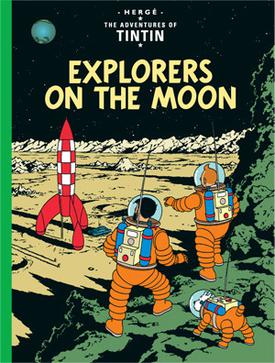

Tintin was a serialized adventure comic by Herge, a Belgian cartoonist, starring a young reporter named Tintin. In 1954, Herge became interested in space travel, and decided to send his character along on the first manned mission to the moon. Inspired by Jules Verne’s From The Earth to The Moon, the 1950 film Destination Moon, and the real life German V-2 rocket, he crafted a technical and realistic tale of men on the moon.

4. The Outward Urge by John Wyndham and Lucas Parkes (1959)-


Though it appears to be co-authored by two people, the author-names listed for this novel are really just two pen names for the same person. John Wyndham created an intricate future history in which he painted a fairly accurate, if belated, picture of the early struggle to reach the stars, first moon landings, and first space stations.

5. Star Trek “Tomorrow is Yesterday” (1967)-


The plot of “Tomorrow is Yesterday” has become a staple trope of the Star Trek universe throughout its nearly fifty year history. The crew of the Enterprise must go back in time to study a specific period of history (in this case, the 1960s), and end up interfering more than they intended to. What makes this episode remarkable is a radio report announcing that the first manned mission to the moon was to take place that Wednesday. Two years later, on Wednesday, July 16th, 1969, Apollo 11 left earth’s atmosphere for the moon.


Keep on glowing in the dark,
Elora

Saturday, April 4, 2015

Character Analysis, Mr. Spock

It was the opening day of my show when I found out about Leonard Nimoy’s passing. I shared some brief words on social media, that day, then expounded on them on my radio show, SpaceTime, that Tuesday. This post is going to be very similar to what I said on SpaceTime. However, it is my first time organizing my thoughts on paper. So, I hope you enjoy this exploration of the character arc of Spock.


How does a character created for a rejected 1960s television pilot become a respected figure in a 2013 blockbuster? How does a an alien from an early sci-fi show that got cancelled after three seasons become a household name- a part of our modern mythology? I’m sure every creative wants to know.
As impossible as it may seem, we find this transformation in the character of Spock. I’m going to briefly explore Spock’s character arc from “The Cage” to Star Trek Into Darkness, and see what has made Leonard Nimoy’s Spock one of the most loved sci-fi characters of the past fifty years.
When we first meet Spock in the unaired Star Trek pilot “The Cage”, he hasn’t quite grown into the stoic-yet-conflicted, logical first officer we know and love. Beginning in 1966, when he is brought back onto the show with Captain Kirk and Doctor McCoy , he represents the intellectual side of the holistic human portrayed by these three men. I discussed the relationship and conflict between them in this past post.
Though Spock represents one aspect of a complete human, as part of the main trio, he also represents a complete human in and of himself. Though Spock is only half-human, he shows the very human struggle between logic and emotion very clearly. Do I listen to my heart or my mind?
While Captain Kirk has to struggle over who on the outside to listen to- Spock (logic), or McCoy (emotion)- Spock has to choose who on the inside to listen to- his human (emotional) half, or his vulcan (logical) half.
This is a struggle that we as humans can all relate to, and it is the struggle we see all throughout The Original Series.
The Animated Series, as goofy as it is, sees the same basic relationship between the three main characters, and the same internal struggle in Spock. However, we also get a peek into Spock’s early experiences that let to his development in TOS in the episode, “Yesteryear”. (Also, there is a seventy-foot Spock clone out there somewhere, that the reboot series should totally revisit. Just saying).
In The Motion Picture, Spock has made his decision. He is going to purge himself of all emotion through the kolinahr ritual. But he fails. This failure plunges him back into the turmoil he experienced in the original series, and he casts his lot with the crew of the U.S.S. Enterprise crew once again. It really seems like he’s happier that way, though.
By The Wrath of Khan, Spock has learned to accept the dichotomy of his existence. He is logical and emotional- Vulcan and Human. He can not dismiss or repress either side of himself. Then, of course, he dies. When his soul is reunited with his body in The Search for Spock, he has to start from scratch.
In the beginning of The Voyage Home, we see a Spock who does not find any relevance in retraining the human part of himself. However, by the end of the movie, he sees the importance of rescuing Chekov from the hospital, even if it is not the most logical move.
The Final Frontier...happened. Alright, ok. Bear with me. Even though Star Trek V isn’t very good, there is an important character moment for Spock- it doesn't even involve gravity boots. His weird half-brother Sybok shows him his greatest pain, a scene which demonstrates the dichotomy between his humanity and his vulcanness. Spock, however, has already come to terms with his deepest pain. He was able to once again reconcile the logic and emotion deep down inside of him.
In Star Trek VI, Spock faces the consequences of his own failure. The young Vulcan officer Valeris, whom he trained to be his successor, turns out to be a warmonger and a spy. Despite this mistake, is Spock still relevant and useful?
It would appear so. In the 2009 Star Trek reboot, Leonard Nimoy’s Spock serves as a mentor and and a counselor to the alternate versions of both Kirk and Spock. His advice to new Spock- to follow his heart and not just his head, not just his head- mirrors the journey Prime Spock took throughout his life.
In Star Trek Into Darkness, Nimoy’s Spock goes against reason, and better judgement, and tells the new Spock how to avoid some of the Khan-related mistakes of his past. The punching and yelling that ensued cannot be blamed on Prime Spock at all.
Logic, emotions, uncertainty, mistakes- these are all things everyone has to sift through and deal with. The thoughtful and nuanced way that Leonard Nimoy portrayed these conflicts in Spock ensure that his character will continue to live long and prosper even after the beloved actor’s death.

Keep on glowing in the dark ,
Elora
kolinahr

Saturday, January 31, 2015

Top-5 (Never mind that anymore...)Day- Inventions, Advancements, and Ideas That Inspired Early Science Fiction

[Insert lame time travel joke here]


I think my laptop forgot to tell me that every other Tuesday is its day off. Well, a list is good any day of the week, right? Even if the name doesn’t sound as snappy?


Today we’re going to talk about the inventions, ideas, and advancements that sparked thought and speculation among early sci-fi writers. Just like the last list, this is in chronological order.


Let’s get started!


5. Aviation-

Throughout history, mankind has wondered what it would be like if he could fly. Writers speculate about the implications as scientists experiment with the possibilities. In its infancy, science fiction had such creations as Leonardo da Vinci’s flying machine designs, the hot air balloon, and early forms of airplanes and rocket propulsion to tinker with.


4. Galileo’s telescope (1609)-


From the beginning, science fiction has flirted with the idea of space travel? What is up there in the dark expanse? What might we find out there where no man has gone before? (Out of timeline, I know. But I couldn’t help it.) Astronomer Galileo Galilei used his telescope to discover many hidden secrets of the heavens, and later scientists improved on his original design to learn even more about the final frontier. (Why not. I already started it).


3. Electricity-


The study of the mysterious force of electricity began long before Benjamin Franklin’s famed kite experiment. Egyptian texts from 2750 BC discuss the powers of electric fish found in the Nile. The eighteenth and nineteenth centuries, however, saw a surge in experimentation with electricity,(pun very much intended). Scientists like Franklin discovered new characteristics and uses of the phenomenon, and the world was revolutionized. It was even discovered in 1791 that the human body utilized electrical signals. That very obviously inspired the plot of Frankenstein, and many other stories.


2. The Internal Combustion Engine (mid 1850s)-
The advent of the internal combustion engine was a new epoch in the history of technology. The power that had been placed into the hands of man seemed to make him invincible. He was better, stronger, and faster. (This is quickly disintegrating into dorky references and puns). Ordinary people could go farther and produce more than ever before. The engine obviously had an impact on what people thought, and wrote about.


1. Darwin’s Origin of the Species (1859)-

Charles Darwin’s theory on naturalistic evolution impacted not only science, but on society as a whole. Once there was a proposition that the natural world could, possibly exist without supernatural intervention, peoples’ relationships with God, nature, and other people were forever changed. For many years, The Origin of the Species served as a sort of holy book for the worldview of naturalism. Much science fiction has adopted this worldview. One of the most notable naturalist sci-fi writers is H.G. Wells.
These are just a few examples of real life ideas and occurrences that prompted sci-fi writers to speculate farther and dig deeper. What else would you add? Was this list interesting to you? Did you think it was redundant? Let me know in the comments!


Keep on glowing in the dark,
Elora

Saturday, September 6, 2014

Geeky Day Trips: The National Air and Space Museum

     It's hard to resist a good space museum. Especially if said space museum is free.

     A few weeks ago, I was able to visit the Smithsonian National Air and Space Museum in Washington D.C.  It is a veritable treasure trove for history buffs, flight enthusiasts, space cadets, and even sci-fi fans.  I could have spent weeks there. There are far to many things to see and read. But I did feel like I accomplished quite a lot, so I thought I would give you a list of things you can do at the National Air and Space Museum.

Things you can do at the National Air and Space Museum:

1. See the original plane developed by the Wright Brothers


     Now, from what I understand, the framework of the plane is the original framework from the first flight in 1903 that launched the world into the aerial age. The canvas in the picture is newer, and the original canvas is in a glass case nearby for protection. Still, it's a pretty major piece of history to behold.


2. Walk Through Skylab


     Skylab was the first U.S. space station. It orbited the earth from 1973 to 1979 for experimental purposes, including solar observation, and multispectral analysis of the earth. At Air and Space, you can walk through a portion of it to get a glimpse of how its inhabitants lived in space. As a special bonus, you can also  see this creepy mannequin guy.

3.  See a gallery of pictures from Mars


     In the upper story of Air and Space, there is a room devoted to pictures taken of our neighboring planet by the Mars Rover. The exhibit is set up to have a sparse and bleak ambiance, sort of like Mars itself

4. Become more informed about NASA's manned space missions


     Downstairs, there is a cool recreation of the Apollo 11 lunar landing module that you should probably take your picture in front of. Upstairs is an exiting exhibit dedicated to NASA's manned space missions, from Mercury to Apollo. There is a great timeline explaining the missions and listing the key players in each one, as well as a plethora of space memorabilia. (Including some control panels from the flights, which you unfortunately can't play with , because they're behind glass).

5. Make your inner (or outer, if you are me) sci-fi fan smile


     Go down to the very bottom level of the museum gift shop, toward the back of the room. There, you will find the U.S.S Enterprise. You should take a picture with  that, too. Also, on the top floor of the museum in general, right across from the Skylab entrance, there is a series of informational posters, one of which is about the original series of Star Trek, and the way it was effected by and had an effect upon our culture. Unfortunately, I did not get a picture of this. Also unfortunately, the poster had an entire blurb about the episode "The Way to Eden" on it. I highly doubt that the creator of the sign watched that episode before mentioning it.

     I hope you enjoyed this little tour of my highlights of the Air and Space Museum in Washington D.C. Do you have exciting Air and Space stories you want to tell? Is there anything I wrote that you want to elaborate on? I'd love to hear about it in the comments. 

Keep on glowing in the dark ,
Elora

Sunday, July 6, 2014

Why Potassium?


Happy Saturday! If you've ever wondered why I would choose such a bizarre name for my blog, hopefully this short anecdote will answer all your questions.


It wasn’t a dark and stormy night or anything. Well, it may have been stormy, given this area of the country. And dark, due to the probable abundance of storm-clouds. It wasn’t night, however. It was day, in the middle of my sophomore year of high school.


  I was paying ever-so-much attention in my Physical Science class. Paying attention, that is, to the periodic table behind my teacher, (I’ve always had an ineffable affinity for the periodic table of the elements). Elements have the funniest symbols sometimes: Au for gold, Ag for silver, Fe for iron, K for Potassium…


    Potassium with a Capital K. Now wouldn’t that make a fabulous title for something? Originally, it was going to be the name of a story podcast, but when I changed the plot for that, its title remained, floating emptily around my mind. And how could I let such an excellent title go unused?

[The elemental symbol for Potassium, ‘K’, comes  from the neo-Latin word Kalium. Neo-Latin was used in formal writing from around A.D 1500-1900]


Keep on glowing in the dark,
Elora

Sunday, May 18, 2014

Christ-figures

I’d say that the most obvious trend to point to when talking about the apologetics of story is the use of Christ-figures. I mean, it has Christ in the title.  I’ve been thinking a lot about these sorts of characters recently. Why are they there? What are they for? Are they a good thing or a bad thing?


It can be a bit uncomfortable at times to see a character in a book or film blatantly compared to the savior of the universe. But so we feel that unease because they serve as a Christ-figure, or is it something else?
 

Maybe we should start by defining our terms. It’s pretty simple, actually. A Christ-figure is a character in literature who possesses some quality or performs some action reminiscent of the Biblical Savior.


What are they for, though? What would prompt a writer to compare their character to Jesus Christ? Think about it. The core message of God’s story is the fall of humanity, and it’s restoration through Christ Jesus. He is the theme of the Bible.  Therefore, in their fictional microcosms, writers create characters with similarities to Christ  in order to communicate their themes.


Then what is it that causes a Messianic comparison to strike us as wrong or blasphemous? It’s not the literary construct itself. In fact, the very idea of the Christ-figure is a testimony to Christ.  The problem is the theme. As strange as it may seem, a character reminiscent of Jesus can be used to convey a theme quite contrary to him. For example, (as much as I hate to cite this book), John Steinbeck’s Jim Casy serves as the Christ-figure in The Grapes of Wrath. While his actions and attributes,(such as his initials being J.C.), can be compared to the Son of God, he represents a humanistic pantheism that is quite anti-Biblical.
Now that that’s out of the way, here are a few more examples from literature and sci-fi, (because this is a geek blog):


-Atticus Finch (To Kill a Mockingbird): His defense of a helpless man- just as Christ it the defender of the helpless human race-- communicates the theme that you should always try to understand a person before you judge them.


-Spock (Star Trek: The Wrath of Khan/The Search for Spock): His sacrificial actions for his ship and crew highlight the ideas of life coming from death and loyalty being stronger than revenge.


-The Doctor (Doctor Who): Over and over again, this man from outside earth is called upon to be the planet’s savior. One of his main themes seems to be that no one is unimportant.


These are just a few I came up with from my recent ponderings. I’m interested in poking around for more themes displayed by Christ-figures. If you have any other examples, I’d love to hear them!

Keep on glowing in the dark,
Elora

Hey there! If you're still reading, thanks for your patience. Hopefully the posts on this blog will become more regular and scheduled come summer. My next post may have something to do with the Theory of Everything, subatomic particles, and Colossians. Hope you enjoy!

Sunday, April 27, 2014

The Science Fiction Syllogism

Alright, alright. It's a little late to be considered a "Saturday" post, but at least I'm getting this up. Have you ever run into a situation where you wished you had a logical reason to give someone for liking sci-fi? Did you ever wish that reason came in the form of a logical syllogism? Well, if you did, I happen to have that very logical syllogism right here. The blue bubbles are the premises, the red is the contrary argument, and the green is the rebuttal. I hope you enjoy!


Keep on glowing in the dark,
Elora