Showing posts with label LLAP. Show all posts

Thursday, April 16, 2015

A One-Year, Fifty-Post Special List!


It’s April 16th. Somehow, by some miracle, this blog has lasted for a whole year! Not only that, but it’s also managed to make it to fifty posts! I’m very grateful to be able to write about these things that I love in light of God’s truth, and share my thoughts with other people. It has been a great privilege and a great blessing. If you’ve been reading this blog from the beginning, or if this is the first post of mine you’ve ever read, I’m grateful for you!


Since it’s sort of a special occasion, I thought I’d write a special sort of post. This is something I’ve wanted to do for a while, and I might do some more of them later on. However, never fear, your regularly scheduled sci-fi history posts will resume after this week. For now, thanks for reading, and supporting me in this crazy blogging venture, and I hope you enjoy this Star Trek “starter kit”.


If you are a geek, you probably want to share the objects of your geeky affections with your friends. However, asking your friends to watch 1960s television, or read 1930s literature with you may attract strange stairs. Suppose for a minute, though, that someone finally caves in to your constant nagging, or perhaps you meet a fellow geek who wants to understand the thing you enjoy better. How do you introduce them to your favorite TV series, book subgenre, or set of movies? That’s what this list is for.


As you’ve all figured out by now, I am a huge fan of Star Trek: The Original Series. Oftentimes, I reference the show, then have to explain myself.  Occasionally, someone will offer to watch it with me, in order to attempt to understand my particular brand of weird. If they follow through with this decision, I have to decide which episode/episodes to show them. So, finally, I compiled a list of what I believe to be the ten most “user-friendly” episodes of Star Trek, that give people a good feel for what the series is. All in good fun, of course.


So, whether you are new to the series yourself, are trying to educate a reboot fan, or just want to do a mini-marathon with your nerdy friends for the fiftieth anniversary next year, I hope you enjoy this list.


1. “Let That Be Your Last Battlefield” (S03-E15)-

I wanted my first episode on this list to include the entire main crew that continues to appear throughout the movies and reboot stuff. So yes, I was doing a lot of nitpicking concerning the helm for this spot on the list. “Let That Be Your Last Battlefield” has everyone: Kirk, Spock, McCoy, Scotty, Uhura, Chekov, and Sulu. Aside from characters, this episode also gives a good feel for the bold, no-nonsense way The Original Series addresses the issues of its day. The endless struggle between the two different groups of aliens on Cheron makes a poignant statement about race relations. Plus, Captain Kirk gives some great speeches, and almost self-destructs the entire Enterprise.


2. “Devil in the Dark” (S01-E25)-

The Original Series introduces so many iconic creatures that it was hard to decide which ones to put on this list, much less which ones to put first. Finally, I decided upon the scary but sympathetic, silicon-based Horta. The antagonist that ends up having sympathetic qualities is a recurring  plot device in Star Trek, and the Horta is a good example of it. Plus, Spock performs a harrowing mind-meld, Bones says some iconic lines, and lots of redshirts die.


3. “The Trouble With Tribbles” (S02-E15)-

Perhaps the most iconic Star Trek episode. Everyone loves tribbles, (except for Klingons). Delta airlines even has tribbles in their safety procedures video. Look it up! Aside from the lovable but prolific furballs, this episode is also notable as one of the few Original Series episodes featuring the Klingons. Plus, all the characters are over the top! Bones and Spock banter, Kirk yells at bureaucrats, Scotty punches the Klingons that insult his ship, Chekov says that everything was inwented in Russia. It’s just fun.


4. “Amok Time” (S02-E01)-

The first episode of the second season introduces a lot of the things people regularly associate with Star Trek- the Vulcan salute, the fight music, Chekov. Plus, it has the entire cast, develops the Vulcan race, and features Kirk and Spock fighting!


5. “City on the Edge of Forever” (S01-E28)-

I’ll freely admit that “City on the Edge” is the best episode of the original series. It presents a fascinating time-travel conundrum, and the characters react in a very realistic, human way. It is a great episode of science fiction television, and provides good character development for the characters. So, why didn’t I put it first? Because, I think the real heart of Star Trek- even when the stories aren’t as good as “City on the Edge”- is the characters. When you get to know the characters first, you’ll enjoy them even more in the very best episode, and you’ll still like them even in “The Way to Eden”- if you can make it through all the singing.


6. “Space Seed” (S01-E22)-

Because you want them to understand Wrath of Khan, right? This episode is a great story of the corrupting influence of power, betrayal, loyalty, genetic engineering and suspended animation starring a well-acted and intriguing villain on its own. But when you pair it with the Wrath of Khan, all sorts of themes, ideas, excitement, crying, screaming, and a little bit of confusion, (who was where what season, huh?) ensue.


7. “The Naked Time” (S01-E04)-
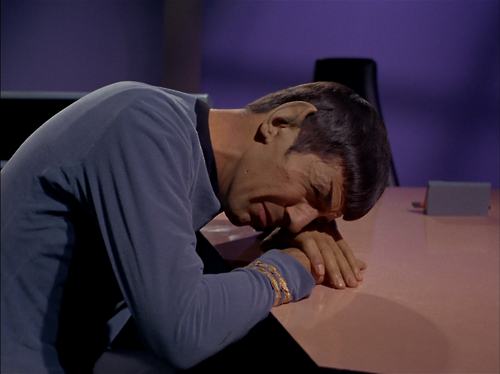
Once you get to know a set of characters, it’s fun to watch them act all out of sorts. Like Spock crying, everyone wants to see Spock crying, (it’s sad, though. I feel for the guy). I’m impressed that the writers were able to so develop the characters in the first three episodes, that the differences in this episode were notable. Also, they invent time warp. Plus, Sulu fences everyone he sees, Kirk dotes on the ship, Kevin Riley, and a lot more clothes than the title implies.


8. “Balance of Terror” (S01-E14)-

This is one of those great, thought-provoking episodes of Star Trek that makes you wonder things like: “are the people I hate really all that different from me?” It introduces the alien race, the Romulans, and their tumultuous relationship with the Federation- a conflict that continues to be an important plot point even into the reboot movies.


9. “Mirror, Mirror” (S02-E04)-

This is the quintessential alternate universe episode of science fiction television. You have probably heard or seen jokes about or references to Spock’s beard even if you haven’t seen this episode. It is an interesting look into the twisted “could-be” Star Trek universe, and brings the characters face to face with the darker side of their natures. Also, Uhura slaps Sulu in the face, Spock calls people illogical, Chekov screams (it happens a lot in the series and the movies, so get used to it), and everyone smiles creepily.


10. “By Any Other Name” (S02-E22)-

This is one of those episodes where you get to see all the characters in their element. Well, except for the ones who get turned into salt cubes. They are in their elements too, just those elements happen to be sodium chloride… Anyway, Kirk, Spock, McCoy and Scotty have to work together to stop some aliens from the Andromeda galaxy from taking over our galaxy. It’s good, old fashioned Star Trek fun. Also, they almost self-destruct the Enterprise, Kirk gets the girl and gets in a fight, and the only female redshirt to die in the entire series meets her demise.


Thanks for reading. I hope you had fun reading through this list, because I most certainly had fun writing it. Thanks for your support and encouragement over this past year. If you have any thoughts on great Star Trek episodes, or any ideas of things you want to see on the blog moving forward, let me know in the comments!


Keep on glowing in the dark,
Elora

Saturday, April 4, 2015

Character Analysis, Mr. Spock

It was the opening day of my show when I found out about Leonard Nimoy’s passing. I shared some brief words on social media, that day, then expounded on them on my radio show, SpaceTime, that Tuesday. This post is going to be very similar to what I said on SpaceTime. However, it is my first time organizing my thoughts on paper. So, I hope you enjoy this exploration of the character arc of Spock.


How does a character created for a rejected 1960s television pilot become a respected figure in a 2013 blockbuster? How does a an alien from an early sci-fi show that got cancelled after three seasons become a household name- a part of our modern mythology? I’m sure every creative wants to know.
As impossible as it may seem, we find this transformation in the character of Spock. I’m going to briefly explore Spock’s character arc from “The Cage” to Star Trek Into Darkness, and see what has made Leonard Nimoy’s Spock one of the most loved sci-fi characters of the past fifty years.
When we first meet Spock in the unaired Star Trek pilot “The Cage”, he hasn’t quite grown into the stoic-yet-conflicted, logical first officer we know and love. Beginning in 1966, when he is brought back onto the show with Captain Kirk and Doctor McCoy , he represents the intellectual side of the holistic human portrayed by these three men. I discussed the relationship and conflict between them in this past post.
Though Spock represents one aspect of a complete human, as part of the main trio, he also represents a complete human in and of himself. Though Spock is only half-human, he shows the very human struggle between logic and emotion very clearly. Do I listen to my heart or my mind?
While Captain Kirk has to struggle over who on the outside to listen to- Spock (logic), or McCoy (emotion)- Spock has to choose who on the inside to listen to- his human (emotional) half, or his vulcan (logical) half.
This is a struggle that we as humans can all relate to, and it is the struggle we see all throughout The Original Series.
The Animated Series, as goofy as it is, sees the same basic relationship between the three main characters, and the same internal struggle in Spock. However, we also get a peek into Spock’s early experiences that let to his development in TOS in the episode, “Yesteryear”. (Also, there is a seventy-foot Spock clone out there somewhere, that the reboot series should totally revisit. Just saying).
In The Motion Picture, Spock has made his decision. He is going to purge himself of all emotion through the kolinahr ritual. But he fails. This failure plunges him back into the turmoil he experienced in the original series, and he casts his lot with the crew of the U.S.S. Enterprise crew once again. It really seems like he’s happier that way, though.
By The Wrath of Khan, Spock has learned to accept the dichotomy of his existence. He is logical and emotional- Vulcan and Human. He can not dismiss or repress either side of himself. Then, of course, he dies. When his soul is reunited with his body in The Search for Spock, he has to start from scratch.
In the beginning of The Voyage Home, we see a Spock who does not find any relevance in retraining the human part of himself. However, by the end of the movie, he sees the importance of rescuing Chekov from the hospital, even if it is not the most logical move.
The Final Frontier...happened. Alright, ok. Bear with me. Even though Star Trek V isn’t very good, there is an important character moment for Spock- it doesn't even involve gravity boots. His weird half-brother Sybok shows him his greatest pain, a scene which demonstrates the dichotomy between his humanity and his vulcanness. Spock, however, has already come to terms with his deepest pain. He was able to once again reconcile the logic and emotion deep down inside of him.
In Star Trek VI, Spock faces the consequences of his own failure. The young Vulcan officer Valeris, whom he trained to be his successor, turns out to be a warmonger and a spy. Despite this mistake, is Spock still relevant and useful?
It would appear so. In the 2009 Star Trek reboot, Leonard Nimoy’s Spock serves as a mentor and and a counselor to the alternate versions of both Kirk and Spock. His advice to new Spock- to follow his heart and not just his head, not just his head- mirrors the journey Prime Spock took throughout his life.
In Star Trek Into Darkness, Nimoy’s Spock goes against reason, and better judgement, and tells the new Spock how to avoid some of the Khan-related mistakes of his past. The punching and yelling that ensued cannot be blamed on Prime Spock at all.
Logic, emotions, uncertainty, mistakes- these are all things everyone has to sift through and deal with. The thoughtful and nuanced way that Leonard Nimoy portrayed these conflicts in Spock ensure that his character will continue to live long and prosper even after the beloved actor’s death.

Keep on glowing in the dark ,
Elora
kolinahr

Saturday, November 1, 2014

The Main Character

Alright! It's finally here! Enjoy!


 On Thursday, I studied all these books. Every one of them, in one way or another, spoke to the idea that humans have a mind, emotions, and a will.

    The metaphysical aspect of a person- the part that isn’t made up of cells and molecules and subatomic particles- can be split into three distinct, yet vitally interwoven parts. (Well, in theory it can be divided. I don’t know of an actually, feasible way to divide the human psyche.) The mind is the intellectual aspect. The part of a person that stores and sorts information. The emotions determine one’s personal internal posture to information and experiences. Finally, it is with the will, or volition, that one chooses a course of action, and carries it out. The will can override the mind and emotions when necessary. All three of these aspects are important, though some personalities tend to be driven by one in particular.

    Why are we like this? It seems to me, that God built the mind, will, and emotions into us when He made us in His image. You see, God is three in person- the Father, the Son, and the Holy Spirit- and one in essence. Though we can only be said to be one person each, our personhood has a sense of threeness to it.

    Fiction seems to have picked up on this facet of human nature. Our genre, science fiction, has many good examples that personify it. If you read last week’s Top-5 list, you know which one I’m going to talk about.


 Yep. Kirk, Spock, and McCoy from Star Trek. The reason I think they make such a good character trio, is that each of them seems to take up the role of one of the three aspects of human nature mentioned above.


 Bones is the emotion. He is the heart of the crew. On any given mission, he can be counted on to bring ethics, humanity, and passion into the discussion. Though his insights may not always line up with all the facts, they must always be considered before going forward with a decision.


Spock, as I think should be evident to most people, is the mind. In many episodes of  Star Trek, he is compared to a computer. He can recall and analyze information, and with little to no emotional bias, offer up all the possible solutions to the problem.


 Captain Kirk is the will. He takes what both Spock and McCoy, (and occasionally other members of the crew like Scotty), have to say, weighs their varying ideas, and makes the best decision possible. Sometimes, he has to override both the emotions and the logic in order to simply do the right thing.

    Therefore,while many may consider Kirk or Spock, or Kirk and Spock, to be the main character of the original series of Star Trek, I contend that the real main character is Kirk, Spock, and McCoy working together.


So, next time your emotions go on a rampage, make sure your will and mind hunt them down and get them back in line before they are able to accidentally cause the Nazis to win World War II. And watch out for people name Edith Keeler. If that made no sense, go watch “City on the Edge of Forever” from the first season of Star Trek. It’s a classic.

Keep on glowing in the dark,
Elora

Tuesday, September 23, 2014

Top 5 Tuesday- Iconic Things That Didn't Happen Until the Second Season

They say good things come to those who wait... And it definitely applies to those who follow a show into its second season...


  1. Beaker was created for The Muppet Show
  
 
What would the Muppet Labs sketches have been like without the hapless, meeping, undefinable orange thing, Beaker? Well, they would have been a lot like season one Muppet Labs sketches, where Dr. Bunsen Honeydew had to test his exploding neckties and earmuffs on himself. (Beaker is my favorite Muppet, and when I realized he was also a second-season stroke-of-genius, I was inspired to write this list.)


  1. David Tennant became the tenth Doctor on Doctor Who


He wasn’t the first Doctor of the series, or even of the relaunch, (technically, the series two he came in on was actually season 28). However, David Tennant’s iteration of everyone’s favorite Time-Lord is definitely a fan-favourite. Doctor Who picked up many new audience members during the tenth Doctor’s run. Which is good.

  1. The theme music for The Twilight Zone


Because you know you whistle it whenever something even vaguely eerie or bizarre happens. The first season theme is a lot harder to whistle if you ask me, and it’s just not as memorable. (But it is still good. Go listen to it on YouTube or something).

  1. Chekov!

(I’ll admit, if this was a list of my favorite things that happened in the second season, Chekov would be number one. He’s one of my favorite fictional characters ever.) For the second season of their popular space show, Star Trek, Gene Roddenberry and company decided they needed a character on the bridge of the Enterprise who would appeal to a young adult audience. Noting the popularity of The Monkees, they decided to style their new navigator after Davy Jones. The character was almost British, but for some reason or other (exactly what this reason was is debated), Roddenberry came to the conclusion that the character needed to be a Russian, since the U.S.S.R. sent the first human into space. So, Chekov joined the crew of the Enterprise, and his zealous patriotism, proclivity toward switching the letter v with the letter w, and his youth and excitement have been a staple of the legendary group ever since. Oh, and they did decide to keep the Davy Jones hairstyle, but since Walter Koenig’s hair wasn’t long enough when he first came on the show, he wore a really terrible wig.

  1. The Vulcan salute


People know the Vulcan salute. People who have no idea who Chekov or Sulu are know the Vulcan salute. People who think Star Trek is Star Wars know the Vulcan salute. People who don’t know what a Vulcan is know the Vulcan salute. And it wasn’t used until the second season of Star Trek. It’s use on the show originated with Leonard Nimoy.He based it off of a blessing he saw the priests do in synagogue as a young boy when he wasn’t supposed to be watching. The salute was first used in season 2, episode 1- "Amok Time".

So, what do you think? Do you have any other examples? More pieces to these stories? Did I include too many Star Trek examples? I'd love to hear from you! 
Keep on glowing in the dark,
Elora