Showing posts with label Genetic Engineering. Show all posts

Wednesday, July 15, 2015

Visions of the Future: The 1930s- As the World Turns

Science fiction had entered its prime. After one-hundred years of history, it was now a bona fide genre with its own name, authors, and magazines. The 1930s were a time of development in the genre in all mediums. You may notice the format of these blog posts changing as we move forwards. That is because there is simply so much science fiction material to cover that I will be spending more time discussing it than I will on the history and technology of a decade.


Summary:

At the end of the 1920s, the western world experienced a devastating financial depression known as the Great Depression. In the United States, this was compounded by a massive drought known as the Dust Bowl in the Midwest. The Gilded age and the Jazz Age had given way to a struggle for survival. The time people didn’t spend on taking care of themselves, they spent trying to distract themselves from the troubles of daily life. The BBC was the first company to broadcast high definition television regularly. Their broadcasts began in 1936.


However, financial troubles weren’t the only dark cloud looming over the future. Foreshadowings of a great war began in the early 1930s, as Adolf Hitler began his rise to power in Germany, and his march across the continent of Europe. At the end of the decade, a discovery was made that would forever alter the nature of war. In 1939, nuclear fission was discovered- a process capable of producing massive amounts of power, and massive amounts of destruction.

Science Fiction:


Literature-

Several of the most acclaimed classic science fiction novels were published in the 1930s, including Olaf Stapledon’s Last and First Men. This massive tome of future history described human civilization from 1930 and onward for two billion years.Stapledon utilized Hegel’s theory of the dialectic, which describes history as a series of conflicts between the thesis (the way things are), and the antithesis (the way things aren’t), resulting in a new thesis. In his speculation, Stapledon anticipated genetic engineering, and pondered the concept of the supermind.


In 1932, Aldous Huxley described a dark and disturbing psychological dystopia  in one of the most highly acclaimed science fiction novels ever written. Brave New World often finds a place on lists of best English-language literature.


Noted theologian and author C.S. Lewis delved into science fiction in 1938 with Out of the Silent Planet, the first novel in his Space Trilogy. These three novels are considered classics both of science fiction and of Christian literature. Out of the Silent Planet is the tale of a quiet philologist named Ransom who finds himself kidnapped and taken to the planet Mars. Lewis explores themes of human nature and corruption, as well as humanity’s place in the natural and metaphysical world.


Magazines and Comics-

Astounding Stories of Science Fiction (later known as Astounding Science Fiction), began publication in 1930. At the end of the decade, in 1938 and 1939, Astounding Science Fiction and Amazing Science Fiction featured short fiction by up-and-coming science fiction author Isaac Asimov.


The superhero subgenre of science fiction gained notoriety in 1938 with the publication of Action Comics #1, the first to feature extraterrestrial friend to humanity, Superman. He was joined by his gritty, detective counterpart in 1939, when Batman made his debut in Detective Comics #37.


Film-

Mary Shelley’s groundbreaking classic was once again put to the silver screen in 1931, when James Whale directed the most iconic Frankenstein film ever. The design for the monster, played by Boris Karloff, has become the standard image of Frankenstein’s monster in popular culture. Two other classic novels were notably adapted in the 1930s- Dr. Jekyll and Mr. Hyde in 1932, and The Invisible Man in 1933 (also directed by James Whale).


In 1936, William Cameron Menzies directed a film written by H.G. Wells called Things to Come. The movie was a fictional discussion on the great and terrible possibilities of the future.


An iconic space hero made his film debut in 1936, when Flash Gordon serials first began to be aired in theatres. Flash was originally a comic strip competitor of Buck Rogers in 1934, and took on a whole new dimension when portrayed on the big screen by Buster Crabbe.


Radio-
Perhaps one of the most infamous incidents in radio history occurred on Halloween night of 1938, when Orson Welles startled some uninformed members of the listening audience with his rendition of The War of the Worlds. Welles’ adaptation of Wells’ classic relied heavily on realistic news broadcasts- causing those who tuned in late to wonder whether Martians really were invading the planet.


Keep on glowing in the dark,
Elora

Thursday, April 16, 2015

A One-Year, Fifty-Post Special List!


It’s April 16th. Somehow, by some miracle, this blog has lasted for a whole year! Not only that, but it’s also managed to make it to fifty posts! I’m very grateful to be able to write about these things that I love in light of God’s truth, and share my thoughts with other people. It has been a great privilege and a great blessing. If you’ve been reading this blog from the beginning, or if this is the first post of mine you’ve ever read, I’m grateful for you!


Since it’s sort of a special occasion, I thought I’d write a special sort of post. This is something I’ve wanted to do for a while, and I might do some more of them later on. However, never fear, your regularly scheduled sci-fi history posts will resume after this week. For now, thanks for reading, and supporting me in this crazy blogging venture, and I hope you enjoy this Star Trek “starter kit”.


If you are a geek, you probably want to share the objects of your geeky affections with your friends. However, asking your friends to watch 1960s television, or read 1930s literature with you may attract strange stairs. Suppose for a minute, though, that someone finally caves in to your constant nagging, or perhaps you meet a fellow geek who wants to understand the thing you enjoy better. How do you introduce them to your favorite TV series, book subgenre, or set of movies? That’s what this list is for.


As you’ve all figured out by now, I am a huge fan of Star Trek: The Original Series. Oftentimes, I reference the show, then have to explain myself.  Occasionally, someone will offer to watch it with me, in order to attempt to understand my particular brand of weird. If they follow through with this decision, I have to decide which episode/episodes to show them. So, finally, I compiled a list of what I believe to be the ten most “user-friendly” episodes of Star Trek, that give people a good feel for what the series is. All in good fun, of course.


So, whether you are new to the series yourself, are trying to educate a reboot fan, or just want to do a mini-marathon with your nerdy friends for the fiftieth anniversary next year, I hope you enjoy this list.


1. “Let That Be Your Last Battlefield” (S03-E15)-

I wanted my first episode on this list to include the entire main crew that continues to appear throughout the movies and reboot stuff. So yes, I was doing a lot of nitpicking concerning the helm for this spot on the list. “Let That Be Your Last Battlefield” has everyone: Kirk, Spock, McCoy, Scotty, Uhura, Chekov, and Sulu. Aside from characters, this episode also gives a good feel for the bold, no-nonsense way The Original Series addresses the issues of its day. The endless struggle between the two different groups of aliens on Cheron makes a poignant statement about race relations. Plus, Captain Kirk gives some great speeches, and almost self-destructs the entire Enterprise.


2. “Devil in the Dark” (S01-E25)-

The Original Series introduces so many iconic creatures that it was hard to decide which ones to put on this list, much less which ones to put first. Finally, I decided upon the scary but sympathetic, silicon-based Horta. The antagonist that ends up having sympathetic qualities is a recurring  plot device in Star Trek, and the Horta is a good example of it. Plus, Spock performs a harrowing mind-meld, Bones says some iconic lines, and lots of redshirts die.


3. “The Trouble With Tribbles” (S02-E15)-

Perhaps the most iconic Star Trek episode. Everyone loves tribbles, (except for Klingons). Delta airlines even has tribbles in their safety procedures video. Look it up! Aside from the lovable but prolific furballs, this episode is also notable as one of the few Original Series episodes featuring the Klingons. Plus, all the characters are over the top! Bones and Spock banter, Kirk yells at bureaucrats, Scotty punches the Klingons that insult his ship, Chekov says that everything was inwented in Russia. It’s just fun.


4. “Amok Time” (S02-E01)-

The first episode of the second season introduces a lot of the things people regularly associate with Star Trek- the Vulcan salute, the fight music, Chekov. Plus, it has the entire cast, develops the Vulcan race, and features Kirk and Spock fighting!


5. “City on the Edge of Forever” (S01-E28)-

I’ll freely admit that “City on the Edge” is the best episode of the original series. It presents a fascinating time-travel conundrum, and the characters react in a very realistic, human way. It is a great episode of science fiction television, and provides good character development for the characters. So, why didn’t I put it first? Because, I think the real heart of Star Trek- even when the stories aren’t as good as “City on the Edge”- is the characters. When you get to know the characters first, you’ll enjoy them even more in the very best episode, and you’ll still like them even in “The Way to Eden”- if you can make it through all the singing.


6. “Space Seed” (S01-E22)-

Because you want them to understand Wrath of Khan, right? This episode is a great story of the corrupting influence of power, betrayal, loyalty, genetic engineering and suspended animation starring a well-acted and intriguing villain on its own. But when you pair it with the Wrath of Khan, all sorts of themes, ideas, excitement, crying, screaming, and a little bit of confusion, (who was where what season, huh?) ensue.


7. “The Naked Time” (S01-E04)-

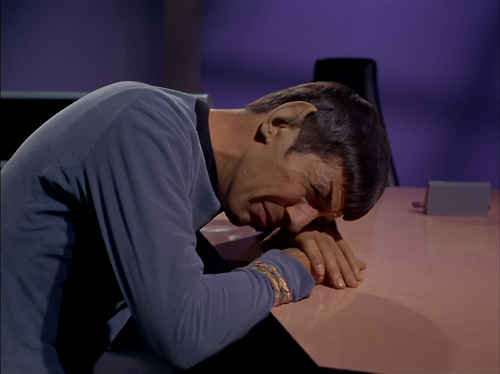
Once you get to know a set of characters, it’s fun to watch them act all out of sorts. Like Spock crying, everyone wants to see Spock crying, (it’s sad, though. I feel for the guy). I’m impressed that the writers were able to so develop the characters in the first three episodes, that the differences in this episode were notable. Also, they invent time warp. Plus, Sulu fences everyone he sees, Kirk dotes on the ship, Kevin Riley, and a lot more clothes than the title implies.


8. “Balance of Terror” (S01-E14)-

This is one of those great, thought-provoking episodes of Star Trek that makes you wonder things like: “are the people I hate really all that different from me?” It introduces the alien race, the Romulans, and their tumultuous relationship with the Federation- a conflict that continues to be an important plot point even into the reboot movies.


9. “Mirror, Mirror” (S02-E04)-

This is the quintessential alternate universe episode of science fiction television. You have probably heard or seen jokes about or references to Spock’s beard even if you haven’t seen this episode. It is an interesting look into the twisted “could-be” Star Trek universe, and brings the characters face to face with the darker side of their natures. Also, Uhura slaps Sulu in the face, Spock calls people illogical, Chekov screams (it happens a lot in the series and the movies, so get used to it), and everyone smiles creepily.


10. “By Any Other Name” (S02-E22)-

This is one of those episodes where you get to see all the characters in their element. Well, except for the ones who get turned into salt cubes. They are in their elements too, just those elements happen to be sodium chloride… Anyway, Kirk, Spock, McCoy and Scotty have to work together to stop some aliens from the Andromeda galaxy from taking over our galaxy. It’s good, old fashioned Star Trek fun. Also, they almost self-destruct the Enterprise, Kirk gets the girl and gets in a fight, and the only female redshirt to die in the entire series meets her demise.


Thanks for reading. I hope you had fun reading through this list, because I most certainly had fun writing it. Thanks for your support and encouragement over this past year. If you have any thoughts on great Star Trek episodes, or any ideas of things you want to see on the blog moving forward, let me know in the comments!


Keep on glowing in the dark,
Elora

Monday, February 23, 2015

Visions of the Future: The 1840s- With Eyes Wide Open


(Samuel Morse's telegraph)
As in the 1820s and 30s, revolution spread rapidly across the globe. However, these revolutions were not only political, they were also philosophical, social, and technological. As the consequences of new ideas began to infiltrate everyday life, both science and fiction served as a sort of mirror, showing people the darker sides of human nature.


History:


Around 1848, violent revolutions in Europe caused mass migrations into America. Immigrants sought opportunity to advance their standing in life under the banner of freedom and democracy. Meanwhile, back in the old world, radical ideas were causing great unrest and violence. In 1849, a group of radical Russian intellectuals, including author Fyodor Dostoevsky, were arrested and sentenced to death for treason. They were brought before a firing squad, but at the last minute, their sentence was changed, and they were exiled to Siberia.


Science:


(Louis Agassiz)
In 1840, acclaimed natural scientist Louis Agassiz was the first to propose an ice age in earth’s past. 1944 saw the first usage of Morse’s telegraph. This was when he sent his famous Biblical message, “What hath God wrought”, (which comes from Numbers 23:23). In 1847, photography was first used in war, giving civilians a grisly look into the horrors of the Mexican-American war.


Stories:

Edgar Allan Poe was still a very influential romanticist author in the 1840s, and wrote several proto-science fiction/horror stories. One of these is the grisly tale “The Facts in the Case of M. Valdemar”. This tells the story of a hypnotist who puts someone into a hypnotic trance just before he dies. It seems to be a precursor to many cryogenic suspension stories, and explores themes of life, death, and the attempted perpetuation of life.


James Fenimore Cooper, the American romanticist of The Last of The Mohicans fame, delved into the newborn science fiction genre with his novel The Crater, in which shipwrecked sailors discover a civilization in a crater on an island previously unknown to the outside.


Yet another romanticist, Nathaniel Hawthorne, wrote a short mad-scientist story, which explored man’s obsession with physical appearance.


Worldview:

If you couldn’t tell, most of the sci-fi of the 1840s came from the worldview of Romanticism. However, during this decade, a new philosophy was devised that would completely change the landscape of society in the middle of the 20th century.


In 1848, the German philosophers Karl Marx and Friedrich Engels created the Communist Manifesto, which outlined their ideas of a perfect society, based on a completely equal society, and a complete rejection of any religion but atheism.

Science was changing. Philosophy was changing. The world was changing. In this time of upheaval and chaos, science fiction writers were still asking questions basic to humanity: how can we prevent death? What happens when we tamper with the human body? What is out there beyond the world that we know?

Keep on glowing in the dark,
Elora

Friday, January 2, 2015

Top-5 Thursday- Interesting Sci-Fi Movies Coming Out in 2015

 
Hello again everyone! I hope you had a merry Christmas, and that 2015 is going well for you so far. Sorry this post is so late. I was busy practicing my sweet hoverboard moves and getting my license to pilot a flying car. If you run into time between your awesome 2015 adventures, and decide you want to see a movie, I have compiled a list of sci-fi movies coming out this year that I think look interesting.

Here it is!
5. Tomorrowland-


Now, I don’t think I’m going to see this movie in the theaters, but I do want to see it at some point. I’m not expecting it to be a blockbuster hit, or a great movie, (you never know; it may surprise me), but I am drawn to the space age aesthetic of the film. And, Tomorrowland has always been my favorite part of Disneyland.

4. Jurassic World-


As bad of an idea as actually opening Jurassic Park is, this movie may still have potential. A little genetic engineering, a lot of great soundtrack. I’m up for it. At least there will be cool dinosaurs.

3. Chappie-


This looks to be one of the more intellectual sci-fi movies of the year. We’ve explored the idea of creating life and consciousness before, but it is always a fascinating study. I’m not prepared to agree with the messages, morals,and meanings presented in this movie, but they could lead to good thought and discussion.

2. Avengers: Age of Ultron-


I, for one, enjoy rogue AI stories. And Avengers movies. I am very excited for this.

1. Star Wars VII: The Force Awakens-


If you’ve been following the blog on Facebook at all, you know how excited I am for this movie. When I first heard that Disney bought Star Wars and was going to make more movies, I thought it was a practical joke for two weeks. Then, I was mad. Then, I went back and forth between thinking Abrams could make a great Star Wars movie, and worrying he would mess it up, (like Star Trek. Wait, did I just say that out loud? Oops…). Now, I’m mostly just excited. Whatever skepticism we Star Wars fans may have over this movie, I know we are all going to squeal like fangirls when that music starts and the opening scroll appears onscreen.

So, what do you think? What are you planning to see this year? What are you planning to avoid? And, what did you think were the best movies of 2014? Let me know in the comments!
Keep on glowing in the dark,
Elora

Thursday, August 14, 2014

Star Wars Not Versus Star Trek


It’s a question of galactic proportions. It’s been debated, bickered over, and bantered about for thirty-seven years. If you are a sci-fi geek, you have probably asked yourself this question at least once -(Spoilers: It’s not 'Doctor Who?' Sorry Whovians. Not this time.) Which is the superior science fiction franchise- Star Wars or Star Trek?


I can feel the fans who adamantly argue one side or the other gearing up to disagree with me. And you may, but I’m not here to argue either side. Today, I’m going to discuss the differences between the two and explain why, on a closer examination, I think that this decades old question may be irrelevant.


Let’s start with setting. This is the basis on which I think the two series are really comparable. They both have “Star” in the title. Aesthetically, they both qualify as science fiction. They both take place in space. They have cool weapons, ships, droids, planets, aliens, and space battles. If you want to debate this debate, these are your categories. However, setting isn't all there is to a story.


Next up in our survey are the ever-so-beloved characters. Both Star Wars and Star Trek are populated by characters that have shaped our modern culture. When trying to do a side-by-side comparison, however, we really can’t fit them into the same molds. At all.


When talking about character archetypes, Star Wars contains fantasy-type characters. There are: Luke- The hero; Obi Wan Kenobi- The wizard/mentor; Emperor Palpatine- The evil sorcerer; and the like.

In Star Trek on the other hand, the characters take their cues more from nautical and military literature. The captains are noble and brave, and universally admired by their crews. There are also some specifically science fictional character types. The best example of this is the alien characters such as Spock and Data. Though Data is an android, he fills the same role as Spock. Both are incredibly intellectual non-humans looking from the outside into humanity. (I personally hold that Star Trek: The Original Series introduced many of the sci-fi archetypes we use today.)


Though Star Wars has aliens and robots, their alien and robot characteristics do not play a major role in their character arcs.


As for plot, Star Wars really only has one- you may be able to argue for two- major plots. The original trilogy is the classic hero’s journey tale- a young boy finding his destiny, rescuing the damsel and saving the world. The prequel trilogy is the inverse story. It is the story of a promising young man who saves the world, then descends into villainy.


Star Trek, on the other hand is made up of multiple science fiction plot lines. They are the quintessential science fiction plot lines: robots, androids, clones, genetic engineering, super weapons, projected reality, aliens and the like.


The themes of the two franchises are inextricably linked to the plots. In Star Wars, the main theme is the fine line between heroism and villainy. An overarching theme of Trek is what it means to be human.


Star Wars is not science fiction in the way Star Trek is. It deserves it’s place in science fiction history because of the advances it made in special effects technology and the popularization of the “used” sci-fi universe. Star Trek deserves it’s place in the history of sci-fi for the revolutionary plots, themes and characters it introduced. So really, in the multiverse of our beloved genre, the occupy opposite ends of the spectrum. They’re not competing for one spot!


Honestly, the entire reason I've thought through this post is that I love both and didn't want to have to pick one or the other.

Keep on glowing in the dark,
Elora

Thursday, June 26, 2014

It's Alive!


 Many people consider Mary Shelley’s Frankenstein to be the first novel that can be concretely classified as science fiction. It is the story of a scientist who discovers the secret of creating life. He uses the science of his day to construct a living creature out of dead tissue. In doing so, both the author and her protagonist stumble upon a moral conundrum that has fueled sci-fi ever since. What happens when man tampers with the affairs of God?


     The question is not so much ‘can man create life?’; that is the domain of scientists. It is the job of science to answer the ‘can we?’. It is the job of science fiction to answer the ‘what if we?’. What if we had the ability to create life?


    Where did we get this kind of a question? We got it in the Garden of Eden when we learned an important but tragic lesson about human pride.


"Then the serpent said to the woman, ‘You will not surely die. For God knows that in the day you eat of it your eyes will be opened, and you will be like God, knowing good and evil.’ So when the woman saw that the tree was good for food, that it was pleasant to the eyes, and a tree desirable to make one wise, she took of its fruit and ate. She also gave to her husband with her, and he ate”. - Genesis 3:4-6 NKJV


     The thing that tempted Eve about the fruit was not that she thought it would taste good, but that she thought it would make her like God. God is the creator of life. Therefore, attempting to mimic this creation is attempting to control our own destiny as humans. Like Eve biting into the fruit of the tree of the knowledge of good and evil, it is attempting to make ourselves like God. No wonder the search for the secret of life fascinates us so much. It has always fascinated us.


    Science fiction gives us a laboratory, if I may, in which to experiment with this idea. Oftentimes in fiction, ‘playing God’ results in disaster, just as it did in reality. Here are a few familiar examples. Though these categories don’t  always show the downsides of tampering with life, or even ask the questions I’m discussing, they very frequently do:


1. Man-made Monsters-


    Frankenstein's Monster, Mr. Hyde, and similar early science fiction and horror icons often leave death in their wake and cause the destruction of their creators.


2. Robots-


    (I’m not going to get into ideas of sentience and personhood right now. That’s a post for another time. Or a lot of posts for a lot of other times.) Though not technically alive, these machines with a personality (and sometimes a temper), can spell doom for humanity. They also have a tendency to try to become the dominant ‘species’ in the cosmos. Think of V’ger or Nomad from Star Trek, the Cylons from Battlestar Galactica, and Ultron from Marvel Comics. (Also, there is a Classic Doctor Who episode called “The Robots of Death”. I thought I would just throw that one out there. )


3. Clones-


    They are pretty similar to robots in their usage, only they’re biological, and made with already existing DNA. Some clones (as well as some robots), can be harmless and even heroic characters. However, they can also be the source of all sorts of moral and practical mixups, chaos and confusion. For example, in the Star Wars prequels, they were corrupted into a huge war-machine made up of identical, expendable soldiers.


4. Genetic Engineering-


     You could say it has its pros and Khans… (alright, that was terrible, but do you know how long I've been waiting to use that one?). On the one hand, you can get someone like Captain America. On the other, you can get someone like Khan Noonien Singh- which is bad.


(Fun and geeky side note- Another member of Khan’s genetically engineered super-race appears in the Star Trek Animated Series episode, “The Infinite Vulcan”)


5. Terraforming-


    Though this creates a different sort of life than the other examples, it is still an example of humans trying to shape and control life. Usually, terraforming stories end with the destruction of pre-existing life, or just failure.  Consider Stargate SG-1 episode, “Scorched Earth”, The Genesis planet of the Star Trek films, and the xeno-terraforming in The War of the Worlds.


    Should man tamper in the domain of God? What would be the result if he did? These are questions that we have grappled with since the beginning of science fiction, and really, since the beginning of humanity. We are created in the image of God, yet we are creatures who are subject to Him. When we try through our own ingenuity to make ourselves great, or exalt ourselves to the loftiness of God, we will always fail. Still, concepts of life from non-life are fascinating to us. There is much to explore, much to learn about the human condition and our place in the universe. What are the limitations? When is it right and when is it wrong? What are the consequences? Why are they there? These are the questions that will continue to inspire science  and fiction until the end of time. And when we genuinely search for answers, we will find them in the Creator and Owner of all life.


Hello again! I'm back! Now that it's summer, I'm hoping to post more regularly. So, don't join me next week, because I'll be out of town....But! After that, I'll try to post articles like this on Wednesdays, exciting top 5 lists on Tuesdays, and random snippets of geekiness on Saturdays. The next of these Saturday shorts will be an explanation of the name of this blog.

Hope you enjoyed this post. If you have any ideas or examples of your own on this topic, please comment! I'd love to hear from you!

Keep on glowing in the dark,
Elora