Tuesday, December 15, 2015

Visions of the Future: The 1980s- Big Business


The 1980s saw an explosion of technology, pop culture and capitalism across the world. Countries that had previously been considered “Third World” countries now wanted in on the economic and social freedom of the “West”. Global issue were brought to the forefront of public attention, as the AIDS epidemic, new concerns about global warming, and the economic crises of developing countries were covered more and more by the media.

The Cold War, between The United States and The Soviet Union ended in 1989. On November 9th, The Berlin Wall, which had separated the Soviet controlled and free halves of Berlin since 1961, was torn down.

New genetic technology sparked controversy in the 1980s, as experiments in genetic manipulation, reproductive surrogacy, and genetic selection were performed. Also, personal computers and video games became less of a hobbyist industry, and more a part of everyday life. The latter half of the ‘eighties saw early stages in the development of the internet.


Science Fiction:
Literature-


In 1980, Gregory Benford, aided greatly by his sister-in-law Hilary Foister, published Timescape, in which scientists in the future (1998), send a message back in time to the 1960s in attempt to avert ecological and social disaster. It is regarded highly for its ability to incorporate strong character development into a hard science fiction story, and received the John W. Campbell Award in 1981.



Also in 1980, Tor Books, an important science fiction publishing company, was founded by Tom Doherty.


William Gibson is an author known for his striking reflections on “space age” science fiction. His short story “The Gernsback Continuum”, published in 1981, tells the story of a photographer who begins to get glimpses into an alternate future as he takes pictures of run-down retrofuturistic architecture. The title references early sci-fi magazine founder, Hugo Gernsback.


In 1983, Octavia Butler published the short story, “Speech Sounds”, which takes place in a post apocalyptic Los Angeles, in which humans have lost the ability to read, speak, or write. The next year,  Gardner Dozois edited the first ever “Year’s Best Science Fiction” anthology.
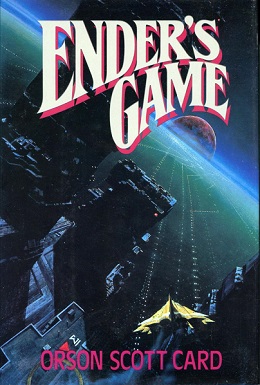

1985 was the release year for what may likely be Orson Scott Card’s most popular work, Ender’s Game. This Hugo and Nebula winning best-seller is a military sci-fi story about children, warfare, and a game that is more than just a game.

Movies-


Blade Runner, which came out in theatres in 1982, was an adaptation of Philip K. Dick’s early cyberpunk short story, “Do Androids Dream of Electric Sheep”. It starred Harrison Ford, who was also working on the Star Wars and Indiana Jones franchises.


The same year, E.T. The Extra Terrestrial was released by director Steven Spielberg. It was a feel-good family movie about a young boy’s friendship with a displaced alien searching for home.
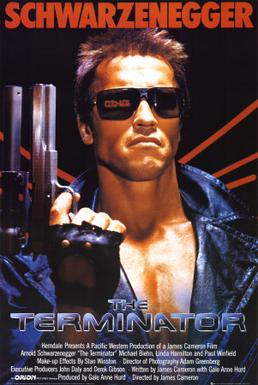

The Terminator  came out in 1984. It starred Arnold Schwarzenegger as a time-traveling robot assassin, and a surprisingly complex sci-fi plot for an action-oriented film.
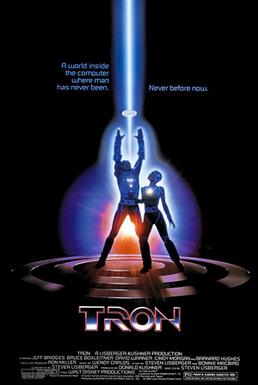

Tron was a story about the inner-workings of a computer program before the general public knew much about computers. Therefore, this 1982 cult-classic by director Steven Lisberger wasn’t recognized as the clever work of art until much later. Tron has gained more popularity recently, and was even given a sequel, Tron: Legacy, in 2010.


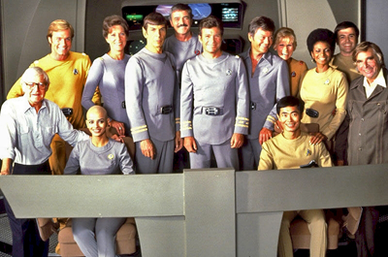
After the box-office success that was Star Trek: The Motion Picture, Harve Bennett and Nicholas Meyer were brought onboard the Star Trek crew to create a movie that would be more appealing to fans than the slow-paced first installment. The result was Star Trek II: The Wrath of Khan- a literary and emotional film that brought back a favorite villain from the original television series, and is widely considered to be the best Star Trek movie. The franchise could not be left in the dire straits Meyer and Bennett had placed it in, though, so the film series continued, with Star Trek III: The Search for Spock in 1984, IV: The Voyage Home in 1986, and V: The Final Frontier in 1989.

Star Wars was a “force” to be reckoned with in the early 1980s, as the uber-popular series cranked out two more episodes in the first few years of the decade. The sequel The Empire Strikes Back came out in 1980, and its cliff-hanger ending was resolved in Return of the Jedi in 1983.


The Back to the Future trilogy began in 1985 with a loving parody of 1980s culture, 1950s culture, and time travel tropes. The series continued with two more installments in 1989 and 1990 that explored the “future” (2015), alternate dimensions, and the Old West.
Television-


In 1981, The Greatest American Hero premiered, starring William Katt  as hapless schoolteacher Ralph Hinkley, who is given a super-powered suit by aliens, then proceeds to lose the instruction manual. This comedic superhero drama lasted for three seasons.


Star Trek got its first live action spin off in 1987, when the Enterprise-D was launched in The Next Generation. It starred a completely different crew, captained by Patrick Stewart as Jean-Luc Picard, and was set in a later period of Starfleet history. Its iconic characters and thought provoking plots have gained it almost as much notoriety as the original Star Trek, and sparked the age-old nerd question: Who is the better captain, Kirk or Picard?


Joel Hodgson pioneered a new concept in science fiction television with Mystery Science Theater 3000, which started on local station KTMA in Minnesota in 1988. It was picked up by Comedy Central, and later The Sci Fi Channel. The premise of the show is that a man was launched into space by mad scientists and forced to watched bad movies as part of a devious experiment. Joel, his successor Mike, and their robot-puppet friends riffed their way through 198 of cinema’s worst movies in the 11 year run of the show.


Quantum Leap is an American cult classic time travel show that first aired in 1989. It starred Scott Bakula as Sam Beckett, a scientist who leaps through time into the lives of figures who lived and died within his own lifetime.


Keep on glowing in the dark,
Elora

Monday, December 14, 2015

Visions of the Future- Top 5 Things that Wouldn't Have Happened Without Star Wars

As we approach the release of a new Star Wars movie, it’s hard to miss all the ways  George Lucas’ space fantasy has saturated our culture. Here are five of the many iconic movies, television shows, and franchises that owe their success, popularity, and sometimes their entire existence to Star Wars.

5. Battlestar Galactica (1978)-


For many young Star Wars fans in the 1970s, Battlestar Galactica was Star Wars on tv- the thing that tided them over until the next movie came out. It’s easy to see why. Do a Google search on Battlestar Galactica, and compare it aesthetically to A New Hope. The resemblance is uncanny. The legends even tell that Gene Coon of Star Trek fame recommended to Glen Larson that he put the word “star” in the title, in order to cash in on the popularity of Star Wars, (and Star Trek, to some degree).


4. E.T. The Extra Terrestrial (1982)-


This feel-good sci-fi came out while the original Star Wars trilogy was still being released. Spaceships and aliens were all the rage. As an interesting side note, there is a theory that E.T. comes from the Star Wars galaxy, as Star Wars figures and a Yoda cameo appear in E.T., and E.T.’s race appears in the senate chamber  in The Phantom Menace.

3. Indiana Jones and the Raiders of the Lost Ark (1981)-


This movie breaks the mold, as it is not sci-fi or pure fantasy. However, this iconic adventure flick, and its sequels, may never have sold were it not for the popularity George Lucas and Harrison Ford had attained after the first two Star Wars movies.

2. Star Trek: The Motion Picture (1979)-


When the actors who played the crew of the U.S.S. Enterprise saw that Imperial Star Destroyer cruise through space in the first few moments of Star Wars, they started looking forward to the phone call from the studio. This is one of the reasons I believe the perceived feud between Star Trek and Star Wars is silly. George Lucas admits to being heavily inspired by Star Trek in creating Star Wars; and, without Star Wars, the cultural phenomena that is Star Trek would have ended at the cancellation of The Animated Series.

1. Pixar (All of it)-


Before the legendary animation company was making everyone cry with their incredible stories and beautiful CG, they were the Graphics Group, which was part of Lucasfilm back in 1979.

Keep on glowing in the dark,
Elora

Thursday, December 10, 2015

Visions of the Future: The 1970s- Trapped Between the Darkness and the Light


The cultural upheaval that characterized the 1960s continued into the 1970s. Revolution and war affected more and more of an increasingly globalized war. While the United States discontinued their participation in the Vietnam War, tensions mounted in the middle east. This led to much violence, and an oil crisis that affected much of the western world, and motivated increased ecological awareness. Social life in the west became atomized, as opposed to the more communal nature of 1960s culture, bringing about what author and journalist Tom Wolfe has dubbed, the “Me Decade”.


Computer technology continued to develop throughout the seventies, especially bolstered by the continuing development of the integrated circuit, or “microchip”. Acclaimed physicist Stephen Hawking proposed his theories about black holes, and the boundaries of the universe. Also, the world’s first space station program, Salyut, was launched by the Soviets in 1971. The United States’ first space station, Skylab, was put into orbit in 1973.

Science Fiction:

Literature-


In 1970, Larry Niven, an acclaimed science fiction author, who had already proved himself through his short fiction, and his work on television shows such as The Outer Limits, published Ringworld. This quirky space adventure told the tale of a two-hundred-year-old man on his journey outside of known space. Niven later added onto this universe with four sequels and four sequels. Ringworld received the Nebula award in 1970, and the Hugo and Locus awards in 1971.


Sci-fi veteran Arthur C. Clarke published Rendezvous With Rama, the story of human explorers sent to investigate an alien ship in earth’s atmosphere, in 1973. It is considered one of his best works, and won the Hugo and Nebula awards for the year of its publication. The same year, Thomas Pynchon published Gravity’s Rainbow. It is a complex tale about a mysterious device implanted in a WWII rocket, that deals with issues both of physics and metaphysics.
The Nebula Award winner for Best Novel in 1974 was Ursula K. LeGuin’s The Dispossessed, which she set in a complex universe full of societies mirroring the clashing political ideologies of earth.


In 1979, Kurt Vonnegut Jr. published Slaughterhouse-Five, which recounted and fictionalized some of his experiences fighting in World War Two. The nonlinear tale is told from the perspective of Billy Pilgrim, a man having flashbacks on his life, while he believes he is trapped in an alien zoo. It takes a postmodern perspective on the significance of life, death, and evil.

Magazines-


In 1972, Ben Bova, who had been running the magazine since John W. Campbell’s death in 1971, officially became editor of Analog Science Fact and Fiction. In 1973, Indiana State  University began publication of Science Fiction Studies, one of the first academic journals on the subject of science fiction. The John W. Campbell Award was established in 1973 in memory of the great science fiction editor. Asimov’s Science Fiction began publication in 1974, and continues to be one of the most illustrious markets in the genre to this day.


In 1979, Darko Suvin published his groundbreaking work on the philosophy of science fiction, Metamorphoses of Science Fiction, in which he describes the nature and purpose of a true science fiction story.

Radio-


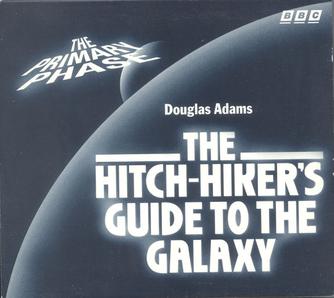
In 1978, the award winning radio drama The Hitchhiker's Guide to The Galaxy was first broadcast on the BBC The quirky, comedic story of a hapless survivor of the late human race as he is dragged on an intergalactic voyage with a motley assortment of aliens and robots, lasted for two series on the radio. Author Douglas Adams later converted his story into a “trilogy” of five novels. It has also been adapted into a television series, a film, and even a video game.

Television-


Science fiction television became wildly popular in the 1970s, with sensations like Star Trek, Star Wars, and Doctor Who bringing the genre great popularity. The quantity of sci-fi shows skyrocketed. Unfortunately, the quantity sometimes came at the expense of quality.


In 1973, three television movies about about an injured astronaut named Steve Austin, who is rebuilt with bionic implants were aired. These were followed up by the five season television show, The Six Million Dollar Man, starring Lee Majors, and its 1976 spinoff, The Bionic Woman, starring Lindsay Wagner. The entire series was based off a 1972 novel called Cyborg, by Martin Caidin.


1973 was also the year that Star Trek’s first spinoff series was broadcast. Star Trek: The Animated series lasted for two seasons, and starred the entire original crew,(minus Walter Koenig, who ended up writing an episode), as their cartoon counterparts. It brought back favorite writers such as David Gerrold and D.C. Fontana, and even brought on acclaimed sci-fi writers like Larry Niven. The Animated Series holds the distinction of being the first Star Trek series to win an emmy, for “How Sharper Than a Serpent’s Tooth”.


Battlestar Galactica, a series aesthetically inspired by Star Wars, first aired in 1978. It is the story of humanity’s struggle to find a new homeworld as they battle the alien-robots, the Cylons. It was created by Glen Larson, who was a Mormon, and some of his theology can be seen reflected in elements of the story. The original series, starring  Lorne Greene, Richard Hatch and Dirk Benedict, was followed up by the less successful Galactica 1980, and a very popular 2003 remake.


Marvel Comics’ The Hulk was brought to life on the small screen in 1978. The Incredible Hulk starred Bill Bixby as tormented scientist Dr. David Banner, and Lou Ferrigno as his big, green alter ego. One of the most memorable aspects of the show was its end theme music, “The Lonely Man Theme”, composed by Joe Harnell.

Movies-

As the “Space Age” coming to a close, the idealistic future people had imagined was not forthcoming. Many of the sci-fi movies of the 1970s reflected the bleak outlook on the future brought about by the Cold War, and other world crises.


The Andromeda Strain, released in 1971, was an alien invasion film. This time, however, the invaders were an alien virus that threatened to wipe out all life on earth. The story was based on the novel by Michael Crichton. It was directed by Robert Wise- who was famous for his work on Invasion of the Body Snatchers, as well as The Sound of Music- and starred Arthur Hill, David Wayne, James Olson, and Kate Reid as four scientists trying to stop the disease from destroying humanity.


Science fiction classic Logan’s Run came out in 1976. It was a dystopian story of a world that was nearly perfect- except for the part where citizens had to die at age thirty. The main character, Logan- played by Michael York- used to hunt down those who tried to escape their fate. On the eve of his own destruction, he sets out with a woman named Jessica- Jenny Agutter- on a quest for life outside the dome.


On May 25, 1977, a science fiction/fantasy film was released that provided a refreshing break from the bleak,apocalyptic fare, and made incredible advances in special effects technology. Neither science fiction nor cinema would ever be the same after George Lucas’ Star Wars, (later Star Wars IV: A New Hope). I’m not going to talk about the movie too much right now, because you’re going to hear an awful lot about it next week, when I blog through the Star Wars saga in preparation for Star Wars VII: The Force Awakens.


The same year as Star Wars came out, Steven Spielberg released Close Encounters of the Third Kind, a unique first contact movie in which aliens make contact with an ordinary worker through telepathic communication.


The Man of Steel appeared in his first feature length film in 1978, in the Richard Donner directed Superman. Superman/Clark Kent was played by Christopher Reeve; Lois Lane was played by Margot Kidder, and arch-villain Lex Luthor was played by Gene Hackman.


1979 saw the release of science fiction/horror thriller Alien, (directed by Ridley Scott), and the Enterprise crew’s big screen debut, Star Trek: The Motion Picture (directed by Robert Wise).

Many of these films would follow the example of Star Wars, creating franchises that continued into the 1980s and beyond.

Keep on glowing in the dark,
Elora
Saturday, November 14, 2015

Visions of the Future: Top 5 Moon Landing Predictions

That the United States successfully landed the first human beings on the moon in 1969 is common knowledge. However, it is less commonly known that many details of this momentous accomplishment were predicted by science fiction decades prior to the actual event.

Here are, in chronological order, five correct predictions science fiction made,(sometimes even inadvertently), about the first moon landing.


1. From the Earth To The Moon by Jules Verne (1887)-


You may be tired of hearing about Jules Verne by now. If so, too bad. This is a series on science fiction history. He is going to come up a lot. While the Apollo 11 mission didn’t see its crew members launched out of a giant cannon towards the moon, many of Verne’s calculations were close to feasible. Perhaps one of the most fascinating coincidences surrounding the story is that Verne’s characters blasted off from Florida. The first moon landing began at Kennedy Space Center, near Orlando, Florida.

2. Woman in the Moon directed by Fritz Lang (1929)-


Two years after his classic silent film Metropolis made cinematic history, director Fritz Lang released this tragic space romance, based off the novel written by his wife, Thea von Harbou. Though the man crux of the film is the drama, it did introduce viewers to new ideas about rocket travel, including the introduction of a multi-stage rocket.

3. Tintin- “Explorers on the Moon” by Hege (1954)-


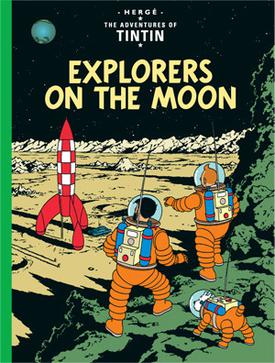
Tintin was a serialized adventure comic by Herge, a Belgian cartoonist, starring a young reporter named Tintin. In 1954, Herge became interested in space travel, and decided to send his character along on the first manned mission to the moon. Inspired by Jules Verne’s From The Earth to The Moon, the 1950 film Destination Moon, and the real life German V-2 rocket, he crafted a technical and realistic tale of men on the moon.

4. The Outward Urge by John Wyndham and Lucas Parkes (1959)-


Though it appears to be co-authored by two people, the author-names listed for this novel are really just two pen names for the same person. John Wyndham created an intricate future history in which he painted a fairly accurate, if belated, picture of the early struggle to reach the stars, first moon landings, and first space stations.

5. Star Trek “Tomorrow is Yesterday” (1967)-


The plot of “Tomorrow is Yesterday” has become a staple trope of the Star Trek universe throughout its nearly fifty year history. The crew of the Enterprise must go back in time to study a specific period of history (in this case, the 1960s), and end up interfering more than they intended to. What makes this episode remarkable is a radio report announcing that the first manned mission to the moon was to take place that Wednesday. Two years later, on Wednesday, July 16th, 1969, Apollo 11 left earth’s atmosphere for the moon.


Keep on glowing in the dark,
Elora