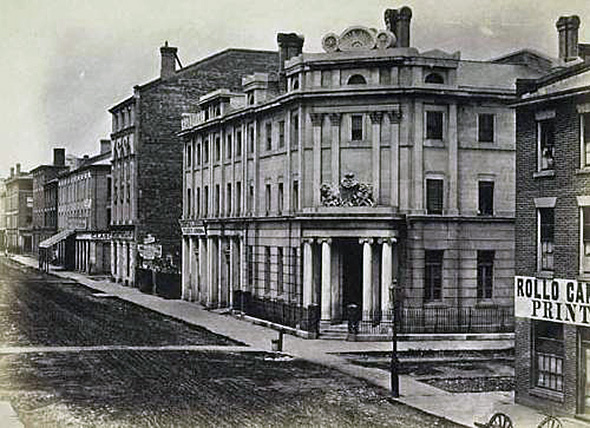
The world was expanding. Technology was expanding. War was expanding. The seeds of the conflicts that would mark the next century were being sown even as early as the 1860s.
History:

After a decade marked almost entirely by conflict, it is relieving to look into history and see the end of a war. In 1860, the Second Opium war between China and Great Britain came to a conclusion. However, the 1860s were hardly a decade of widespread peace. The United States waged a bloody civil war from 1861 to 1865. In 1865, President Abraham Lincoln was assassinated, stagnating the nation’s already slow advance towards peace and restoration. In 1864, the Austro-Prussian war began. This was only a small part of the ill-will and resentment that was festering in Europe, which would eventually escalate into the widespread terror of World War I.
Science:

(Mendeleev and his periodic table)
The 1860s saw many advances in the organization and implementation of the sciences. For example, in this decade, Russian chemist Dmitri Mendeleev organized one of the earliest versions of today’s periodic table of the elements, (yes, it actually was invented in Russia!). Also, Gregor Mendel developed his laws of genetic inheritance. International science exhibitions came into popularity during the 1860s, with one taking place in London in 1862, and another in Paris in 1867.
Many previously invented technologies came into everyday usage. For example, the transatlantic telegraph was installed in 1866, and the United States’ Transcontinental Railroad was completed in 1869.
As for new inventions, Alfred Nobel invented dynamite in 1867, (it will forever amuse me that the guy who invented dynamite has a peace prize named after him), and an early submarine was developed in 1869.
Stories:

I consider there to have been three main periods in the first 100 years of science fiction. The first period was marked by several writers who were mainly Romanticist in their philosophy. Think of the early stories by Mary Shelley, Edgar Allan Poe, and others. This period came to an end around the 1850s-60s. The next period was dominated by one author in particular, a modernist Frenchman named Jules Verne. Maybe you’ve heard of him. The Vernian age of science fiction (is that too dramatic? Because I like it), lasted approximately from the 1860s to the 1880s, when he began to be upstaged by one H.G. Wells.
In 1863, Verne published a follow-up novel to his short story “A Voyage in a Balloon”. Five Weeks in a Balloon had a similar theme and plot to the 1851 lighter-than-air adventure, but with an expanded scope. In 1865, Jules Verne published one of his most popular and fascinating stories, From the Earth to the Moon. It told the story of a group of gun-enthusiasts in Baltimore who invented a space-gun, with which they propelled themselves towards the moon. This story predates the actual moon-landing by over a hundred years, and bears an eerie resemblance to the actual event. For example, Verne launched his characters into space from a base in Florida. The Apollo 11 mission started at the Kennedy Space Center in Merritt Island, Florida. Verne’s calculations for the cannon were very nearly accurate, but the muzzle would have needed to be much longer to achieve actual space flight.

Though Jules Verne was most definitely the most influential sci-fi author of the time, he was not the only one. In 1868, Edward F. Ellis published the first science fiction dime novel, The Steam Man of the Prairies, a quintessential story in the budding Edisonade genre. This genre was inspired by prolific American inventor, Thomas Edison, and usually starred boy-geniuses and their wacky inventions.

In 1869, Edward Everett Hale published The Brick Moon, the first work of fiction to feature an artificial satellite populated by humans.
Worldview:

It is fascinating to note how much the early 20th century was impacted by the events, ideas, and innovations of the 1860s. For example, the seeds for one of the most destructive ideologies in the past century, Communism, were sown in 1867, when Karl Marx first published his thoughts on society in Das Kapital.
The world would never be the same after the 1860s. The stage was set, and the drama that would consume the next century was already in motion.
Thanks for reading! I’ll be back tomorrow with a very special post. It will be my one year anniversary of writing this blog, as well as my 50th post. It will deviate from our trek through sci-fi history, (though trekking will most definitely be involved), but I think it will still be pretty fun. I hope you can join me. As always, I’d love to hear from you in the comments!
Keep on glowing in the dark,
Elora